How shame can shape our reactions, relationships, and the way we see ourselves.
Years ago, a couple in my therapy office shared a story about an anniversary dinner that took an unexpected turn.
The wife had spent time preparing a special meal for her husband. She was excited about trying a new recipe, and when they sat down to eat, he was equally enthusiastic. He told her how delicious everything looked, commented on how good it smelled, and eagerly took his first bite.
Then he asked a simple question: "Are there tomatoes in this?"
"Yeah, why?" she responded, her tone suddenly defensive.
He was genuinely confused. He liked tomatoes. He wasn't criticizing the meal or suggesting anything was wrong with it. He was simply curious.
But something had shifted. She'd been enjoying his appreciation and their shared excitement about the dinner. His question, innocent as it was, interrupted that experience. For a brief moment, she felt something uncomfortable, and her response reflected it.
Now he felt confused and a little defensive himself. What had started as a lovely anniversary dinner suddenly felt tense. Neither had intended to upset the other, yet somehow they'd gone from feeling connected to feeling disconnected in a matter of seconds.
So what happened? And what might shame have to do with it?
Another Way to Understand Shame
By now, most of us have probably heard the distinction between guilt and shame: Guilt says, "I did something bad," while shame says, "I am bad."
But what if there's another way to understand shame? One that helps explain why we sometimes become defensive, angry, or withdrawn even when no one has criticized us or we've done nothing wrong?
Psychologist Silvan Tomkins offered a different perspective. He proposed that shame can arise when a positive emotional experience, such as excitement, enjoyment, interest, or connection, is unexpectedly interrupted.
Think about that for a moment. You don't necessarily have to do something wrong or be criticized to experience shame. Sometimes, shame can arise simply because something you were enjoying was unexpectedly interrupted.
What's particularly interesting is that Tomkins understood shame as an automatic emotional response, not simply a belief that we're inadequate or have done something wrong. We may experience it physically, as a sinking feeling in our stomach, a tightening in our chest, or an urge to look away, before we've even had time to make sense of what happened.
In other words, shame can show up in our bodies before we recognize it in our thoughts.
In the anniversary dinner example, the husband's question may have interrupted the moment of connection. Even though it was an innocent question, a moment of joy suddenly shifted and triggered a shame response before she even understood why.
And perhaps even more interesting is what happens next.
Shame doesn't always look like shame. Sometimes it looks like defensiveness, anger, withdrawal, self-criticism, or avoidance. We may not even recognize that shame is part of what we're experiencing.
The Compass of Shame
Psychiatrist Donald Nathanson developed a model called the Compass of Shame, which describes four common ways people respond to shame: Withdrawal, Attacking Others, Self-Criticism, and Avoidance.
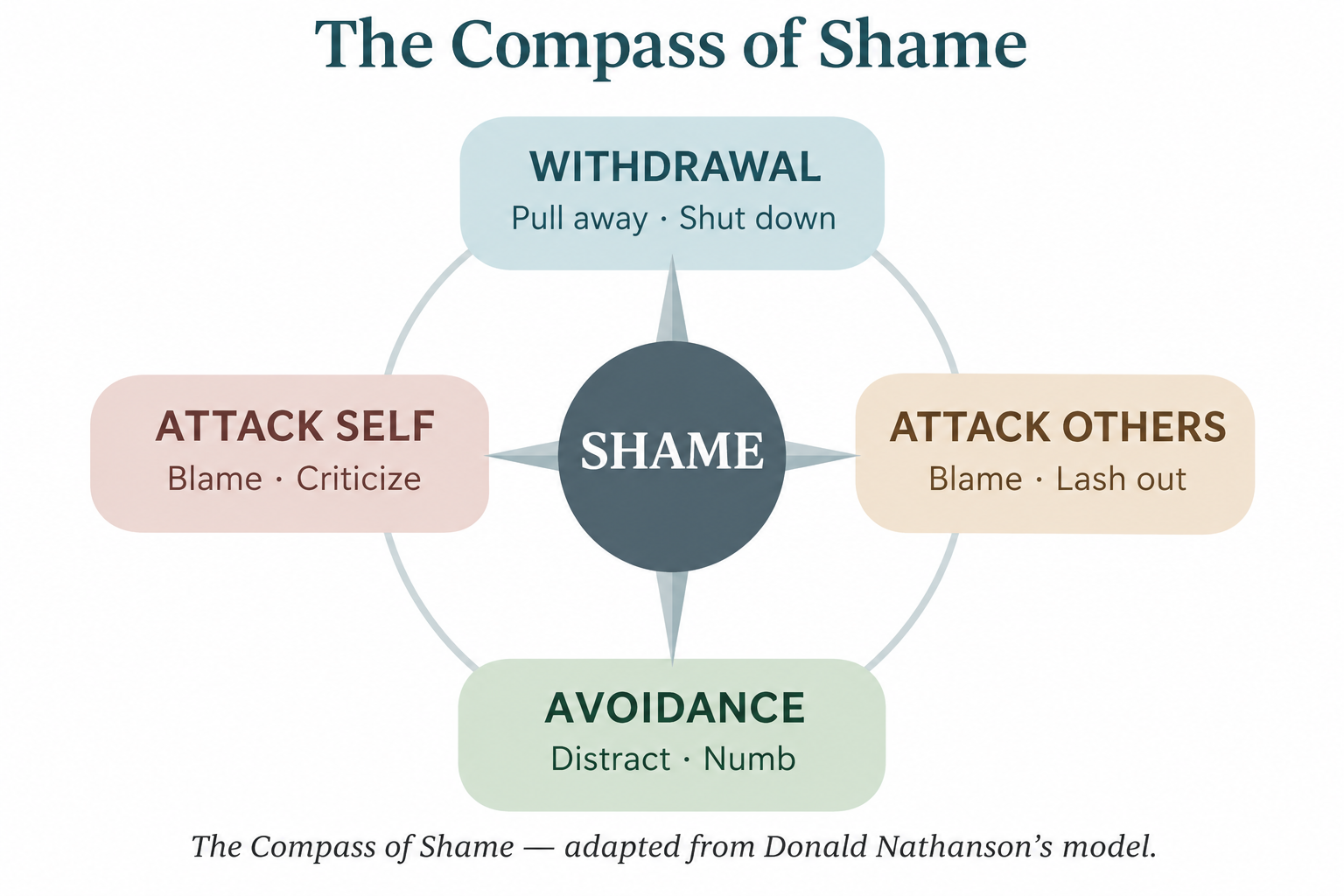
Most of us probably recognize ourselves in more than one of these responses. We may even move between them depending on the situation.
What If We Looked Beneath the Behavior?
You start telling your partner a story, notice they're distracted, so you stop talking. You’re excited to see someone at a party, but realize they don't remember you, and immediately criticize yourself for approaching them. You share an idea at work, someone asks a question and you snap back defensively. You find out you didn't get the promotion you were expecting, so you pour yourself a few drinks rather than think about it.
Four ordinary situations. Four different reactions. And perhaps the same uncomfortable emotion underneath them.
We might see defensiveness, distance, self-criticism, or avoidance. But what if shame is playing a role?
That doesn't mean shame explains every behavior. Sometimes people are simply angry, overwhelmed, or distracted. But considering shame as a possibility encourages us to look beyond what someone is doing and become curious about what they might be experiencing.
And that includes ourselves.
Understanding Makes Room for Compassion
When we recognize that someone's behavior might be an attempt to protect themselves from shame, it becomes easier to have compassion and respond with curiosity rather than immediately reacting with frustration or judgment.
Instead of asking, "Why are you being so defensive?" we might wonder, "What about this feels threatening?"
Instead of criticizing ourselves for avoiding something difficult, we might ask, "What am I afraid I'll feel if I face it?"
Of course, understanding a behavior doesn't mean excusing it. We can have compassion for someone's emotional experience while still expecting accountability for how they respond..
Sometimes, understanding what's beneath a behavior is what allows us to respond differently. The next time someone's reaction seems bigger than the situation calls for, consider that they may be responding to something you can't see.